
"ICP" has a couple key meanings:
1.Insane Clown Posse: a duo of prolific Detroit rappers/borderline cult leaders/grown men in clown makeup.
2. Ideal Customer Profile: a crucial, often undervalued staple of a high-functioning sales org.
HubSpot wouldn't give me budget to survey 300 sales leaders about the clown rappers — so you'll have to settle for an email about how to appeal to your best-fit prospects. Believe me, I'm disappointed too.
Almost everybody has an ICP. Almost nobody enforces it.
Our survey found:
43%
of sales leaders say their reps determine prospect fit primarily using subjective judgment elements—manager guidance (22%) and personal experience (21%). Only 14% have documented qualification criteria.
26%
of sales leaders say they have documented disqualification criteria reps are expected to apply.
23%
of sales leaders say they discourage disqualification unless the prospect ends the conversation.
Every org has customers with profiles more ideal than others', but half-assed ICP enforcement can undermine how reps resonate with them.
Over three times as many orgs determine prospect fit with instinct rather than documented qualification criteria — and those flimsy standards exist further down the funnel, too.
Only 26% of orgs have actual disqualification criteria, and 23% actively discourage reps from ever walking away.
Without firm standards and the ability to apply them, reps wind up treating their ICPs like Sid did Woody in Toy Story — saying, "I don't want to play with you anymore," and keeping that insight buried in documents nobody looks at.
If you're struggling with bad-fit prospects, consider how you apply your ICP versus how you define it.
AI doesn't make your outreach generic. Your ICP gap does.
Our survey found:
23%
of sales leaders say their reps want industry-specific pain points and trends more than any other ICP-supporting resource.
20%
of sales leaders say their reps want competitive intelligence more than any other ICP-supporting resource.
20%
of sales leaders say generic output is their number one problem with AI-supported outreach.
AI has a reputation for churning out flat, forgettable email copy — inbox wallpaper better suited for converting prospects into pissed-off anti-evangelists than leads.
A plurality of sales leaders get that. They see generic output as AI outreach's main drawback.
It's easy to look at a shoddy AI email and blame the tech, but that's shortsighted.
Our data indicates that industry-specific pain points and competitive intelligence are the ICP-related resources reps wish they had most — vertical-unique, meaningfully contextual data to feed their models.
Thin input makes for thin output. Generic outreach is evidence of an ICP-knowledge gap, now visible at scale.
It might sound obvious, but solving the output problem starts with solving the input one.
What can you do with this next-level insight?
For reps:
Defend fit with criteria, not gut, in pipeline reviews. "They match X and Y" holds up under scrutiny; "I've got a good feeling about this one" is exactly the instinct-over-evidence habit the data says is costing teams.
For managers:
Build and maintain a shared library of ICP pain points and competitive intel so no rep has to reinvent the same research alone. Centralizing input is the fastest way to raise the floor for everyone's output.
For leadership:
Turn competitive and industry intelligence into a maintained, centralized asset instead of tribal knowledge scattered across individual reps. Insight that lives in one rep's head doesn't scale, and it walks out the door when they do.
"I could easily give all of this up — stop writing the single most practical, compelling sales newsletter available. But I don't. I don't because I know you need this insight. Also, I need money to buy food and/or not live with my mom at age 32."
Jay Fuchs. Managing Editor, The Science of Scaling Newsletter
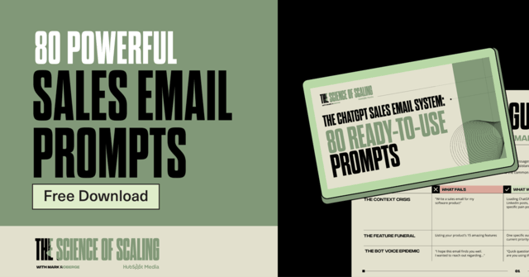
80 prompts for (almost) every sales scenario
Save this library for 80+ copy-paste inputs that get to the point with gusto. We covered a slew of key sales-related brackets:
- Trigger events (hiring spree, press recognition)
- Value-first (free resource, problem diagnosis)
- Relationship building (build rapport, support creators)
- And so much more!
Because writing all your pitches from scratch, while admirable, is wildly inefficient.
The data in question
As always, we sourced our data through Panoplai: To borrow from Charli XCX in 2012, "I don't care (about other panoramic research platforms) — I love it ("it" being Panoplai (the panoramic research platform that's better than every other panoramic research platform (hence why I love it)))."
How do BDRs/AEs currently determine whether a prospect fits your ICP during qualification?
- Documented qualification criteria — clear checklist of firmographic attributes and fit signals to verify - 14%
- CRM scoring or tagging system — automated or manual indicators showing ICP alignment - 21%
- Manager guidance on individual deals — ask leadership whether specific prospects qualify - 22%
- Personal judgment from experience — use pattern recognition from past wins/losses - 21%
- Pursue all interested prospects — let deal progression determine fit rather than upfront qualification - 10%
- None of the above - 14%
Does your organization have explicit criteria or a framework that gives reps permission to disqualify or walk away from a deal?
- Yes — documented disqualification criteria reps are expected to apply - 26%
- Somewhat — we encourage disqualification, but the criteria aren't formalized - 23%
- In theory — disqualification is discussed but rarely practiced - 19%
- No — walking away is generally discouraged unless the prospect ends the conversation - 23%
- We're currently developing disqualification criteria - 6%
- We tried implementing this but reps were resistant or inconsistent in applying it - 3%
What resources or information do reps most commonly wish they had to prospect and sell more effectively to your ICP?
- Customer stories and case studies from similar ICP companies — proof points that resonate with target profile - 14%
- Industry-specific pain points and trends — contextual knowledge to personalize outreach and discovery - 23%
- Competitive intelligence for ICP segment — what alternatives prospects currently use and why they switch - 20%
- Messaging and positioning tailored to ICP — email templates, call scripts, pitch decks specific to target customer - 15%
- Better data on prospect fit signals — richer company information to validate ICP match before outreach - 15%
- None of the above - 13%
What's the biggest challenge your team faces when using AI to write sales emails?
- Generic output — emails lack the personalization prospects are receptive to - 29%
- Weak prompting skills — reps don't know how to write effective prompts that produce quality results - 16%
- Brand/voice misalignment — AI-generated emails don't match our sales methodology or tone - 16%
- Context inefficiency — we can't efficiently feed AI the information needed for quality output - 16%
- Compliance concerns — leadership worries about accuracy, brand risk, or regulatory issues with AI content - 10%
- None of the above - 21%