

What is a "closer"?
A relief pitcher? An unsettling Nine Inch Nails song you regret showing your girlfriend? The kind of person coffee is for (according to Alec Baldwin)?
It's all of the above — plus something any rep looking to advance the field needs to be.
We ran surveys of over 300 sales leaders to figure out what reps need to do to close effectively (and how managers and leadership can scale those tactics).
The thing that shows up in most wins is the thing fewest teams train reps to look for at close.
Our survey found:
38%
of sales leaders say internal champions factor into 50–100% of their closed-won deals — combining those who place them in the majority (28%) and nearly all (10%).
14%
of organizations formally train reps to identify an active internal champion as a positive signal before pursuing a close — the lowest-trained closing signal in the survey.
What do Boomers who resent entire generations for not rejecting participation trophies they were given as children and a plurality of sales leaders agree on?
"Champions matter."
Only 16% of our respondents say none of their closed-won deals involve internal champions — versus 38% who say they factor into 50-100% of them.
However, only 14% of leaders formally train reps to verify that they have an internal champion actively selling before pursuing a close.
The signals teams do train on — shared timelines (31%), prospect-initiated engagement (29%), decision-maker access (26%) — generally live downstream of that step.
The fix isn't adding a checkbox. It's reordering the checklist so champion verification comes first.
The green light signals that live beyond it might be unreliable without it.
When you can't walk away from a deal and believe every objection is a sign of interest, dead deals become immortal.
Our survey found:
34%
of sales leaders hold the plurality view that objections are a natural part of every deal — they signal engagement, not rejection.
23%
of organizations say walking away from a deal is generally discouraged unless the prospect ends the conversation — removing the structural exit ramp.
Updating data is less systematic and more "patchwork-a-matic" (a totally real term I didn't just make up) for many sales orgs.
24% of our respondents use a "mixed approach" for keeping their contact and account data current, and another 23% say their reps update records by habit.
Those strategies don't align with what respondents cite as the most effective data hygiene practices: recurring cadences (20%), automated enrichment (20%), and assigned ownership (19%).
That's a stark pattern.
Teams often default to convenient, ad hoc data-updating approaches — only to discover that the most effective methods require stricter fixes.
The most productive data hygiene solutions aren't exotic or abstract. They're regimented.
What can you do with this next-level insight?
For reps:
Ask whether your champion can articulate your value prop to their CFO without you in the room. If they can't, you have a friendly contact, not an advocate. The distinction changes your forecast.
For managers:
Ask each rep to name one deal they'd disqualify today if given permission. If the answer comes fast, the problem isn't rep judgment — it's that your pipeline culture penalizes the honest call.
For leadership:
The gap between "champions appear in most wins" and "we don't train reps to verify them" is a process design problem, not a rep-skill problem. Fund champion-readiness enablement between discovery and proposal.
Macho Man Randy Savage once said, "I'm the tower of power, too sweet to be sour. I'm funky like a monkey. Sky's the limit and space is the place."
Do I know what that means? No. Does it sound cool? Yes. Do I need something quirky to put in this inside joke section I always include? Also yes.
So let's pretend we all understand what he meant and assume it applies to me too.
Jay Fuchs. Managing Editor, The Science of Scaling Newsletter
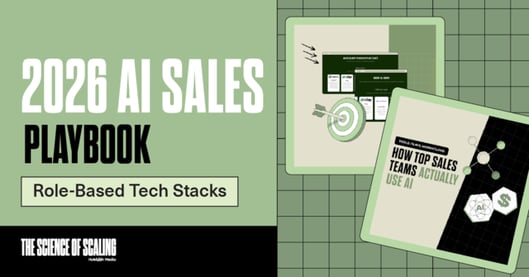
This is not just one good tech stack
It’s 5 tools, 3 plays, and 3 prompts each to spoil every single member of your sales team, from reps to executives.
The Science of Scaling’s Modern AI Sales Playbook focuses on bridging operations and optimizing high-impact workflows to drive more revenue.
What’s inside:
- Role-based tech stacks tailored to how people really work
- Workflow walkthroughs that demonstrate strategies in practice
- Substantial sales plays across coaching, forecasting, prospecting, and deal execution
Unify your team with AI tactics.
The data in question
As always, we sourced our data through Panoplai: It's by far the best panoramic research platform on the market. If you can find one better, you're either wrong or delusional.
What percentage of your closed-won deals involved an active internal champion (someone inside the prospect's organization advocating for you)?
- 75–100% — internal champions are essential to our sales motion — 10%
- 50–74% — internal champions significantly improve win rates — 28%
- 25–49% — internal champions help but aren't always present in wins — 20%
- 10–24% — we occasionally benefit from internal champions but don't rely on them — 17%
- Under 10% — internal champions rarely factor into our closed deals — 10%
- None of the above — 16%
Which of the following positive deal signals does your organization formally train reps to identify before pursuing a close? (Select all that apply)
- Champion identified — champion has been identified and is actively selling internally — 14%
- Decision-maker access — access has been granted to the economic decision-maker — 26%
- Specific timeline — prospect has articulated a specific timeline or compelling event — 31%
- Budget shared — prospect has shared budget or procurement details — 25%
- Proactive engagement — prospect engages proactively, returning calls and scheduling follow-ups without prompting — 29%
- No formal training — we don't formally train reps on specific positive deal signals — 12%
Does your organization have explicit criteria or a framework that gives reps permission to disqualify or walk away from a deal?
- Documented criteria — yes, documented disqualification criteria reps are expected to apply — 26%
- Encouraged but informal — somewhat, we encourage disqualification, but the criteria aren't formalized — 23%
- Discussed but rare — in theory, disqualification is discussed but rarely practiced — 19%
- Generally discouraged — no, walking away is generally discouraged unless the prospect ends the conversation — 23%
- Currently developing — we're currently developing disqualification criteria — 6%
- Tried but inconsistent — we tried implementing this but reps were resistant or inconsistent in applying it — 3%
Which of these statements most closely reflects your philosophy on objection handling?
- Insufficient value — objections are a symptom of insufficient value establishment earlier in the process — 7%
- Natural engagement — objections are a natural part of every deal, they signal engagement, not rejection — 34%
- Smokescreens — most objections are smokescreens, the real issue is almost never what the prospect says first — 16%
- Coaching problem — objection handling is primarily a coaching problem, reps can be trained to handle virtually any pushback — 13%
- Preventive — the best objection handling is preventive, great discovery and positioning eliminate most resistance — 17%
- Overemphasized — objection handling is overemphasized, deal outcomes depend more on qualification and timing — 6%
- None of the above — 6%