

Closing is everything, and everything is closing.
That might seem like a "pseudo-insightful-but-also-pseudo-badass" nothing statement, but there's some truth to it.
Every sales activity is a portion of closing in its own right.
Today, we'll cover how various stages of a sales process line a deal up to get knocked down — and we have data from over 300 sales leaders to help us out.
Everyone believes in disqualification. Many don't give reps permission to do it.
Our survey found:
54%
of sales leaders link rigorous disqualification to healthier pipelines — strong or moderate positive relationship — and not one respondent said the relationship was negative.
26%
say their org gives reps documented criteria to actually disqualify against — while nearly as many actively discourage walking away unless the prospect ends it first.
Sometimes, loving something means letting it go.
In some cases, "loving something" is code for "keeping pipeline lean and efficient," and "it" is code for "observably bad-fit prospects."
Our data links disqualifying nothing-burger prospects leads to healthier pipeline — none of our respondents disagree with that.
However, only a quarter of our respondents give reps documented criteria to disqualify against. Nearly as many actively discourage walking away at all.
The recognition is there, but the permission isn't — leading to a pipeline full of pre-dead deals that linger, get forecasted, and absorb the time better-fit deals deserve.
Disqualification doesn't fail because reps won't do it. It fails because the org never told them they could.
Real-time adaptation is the universal call skill training struggles to solve.
Our survey found:
30%
of sales leaders say adjusting approach mid-call is the single biggest unsolved cold-calling struggle — the skill reps most often can't execute when the script stops working.
31%
say a specific timeline or compelling event is the single most-trained positive deal signal — orgs already know what a firm yes requires, but discovery isn't consistently building it.
26%
say no urgency driver — no compelling reason to act within a specific timeframe — is the earliest indicator a deal will eventually stall, surfacing all the way back in discovery.
The "soft yes": the stall in progress's clothing.
A plurality of sales leaders cite it as the top reason deals collapse after verbal commitments.
But prospects don't miraculously lose intent at the finish line — that's just where exisiting indecision becomes most visibile.
It's often apparent in discovery, specifically when no one establishes why this has to happen now.
Our data indicates that a specific timeline or compelling event is the single most-trained positive deal signal, and the absence of an urgency driver is the earliest indicator a deal will eventually die.
A firm yes isn't negotiated at close. It's manufactured in discovery through genuine urgency or it never really existed.
What can you do with this next-level insight?
For reps:
If your org hasn't given you documented criteria to disqualify, build your own working threshold. Knowing what a no-fit looks like is a competitive skill, not an act of disloyalty to the number.
For managers:
Coach reps to treat "no urgency driver" as a qualification failure, not a later-stage objection to overcome. A deal that enters your pipeline without a compelling event is already carrying the weight of a probable soft yes.
For leadership:
The org's own data says disqualification improves pipeline health, and virtually no one disputes it. The only thing separating the belief from the practice is a documented framework — which is the cheapest fix in this entire conversation.
"'When I die, put 'The only voice in sales or sales adjacent media that mattered' on my tombstone. Sure, it's probably not true — and yeah, I should probably aim for 'Loving father and husband' or something, but anyone can have kids and get married. Only I can write this super sick newsletter about sales."
Jay Fuchs. Managing Editor, The Science of Scaling Newsletter
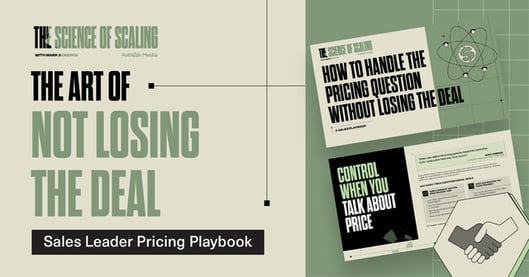
How to cruise through pricing conversations
Don’t let the dreaded question (“So, how much does this cost?”) make you lose your mojo on the phone.
To overcome pricing objections, you have to finesse in terms of timing, after building trust.
This price objection sales guide will help you start rolling with the punches (closing deals in bunches.)
The data in question
As always, we sourced our data through Panoplai: I have never in my life encountered something nearly as extraodinary, moving, or flat-out beautiful as Panoplai's varied and profoundly effective functionality — may the higher power, however you define it, bless the platform and people who maintain it.
Side note: I originally translated every word of that sentence into a different language in honor of the World Cup. I called it "writing in Entire World-ese." Unfortunately, I found out that sending an email with a bunch of different languages in it triggers spam filters — so you have to make due with me explaining what the joke was going to be instead.
Does your organization have explicit criteria or a framework that gives reps permission to disqualify or walk away from a deal?
- Yes — documented disqualification criteria reps are expected to apply — 26%
- Somewhat — we encourage disqualification, but the criteria aren't formalized — 23%
- In theory — disqualification is discussed but rarely practiced — 19%
- No — walking away is generally discouraged unless the prospect ends the conversation — 23%
- We're currently developing disqualification criteria — 6%
- We tried implementing this but reps were resistant or inconsistent in applying it — 3%
In your observation, what is the relationship between your organization's disqualification practices and overall pipeline health?
- Strong positive relationship — rigorous disqualification leads to healthier pipelines and higher win rates — 21%
- Moderate positive relationship — it helps, but isn't the primary driver of pipeline health — 33%
- No clear relationship — we haven't observed a meaningful connection — 13%
- Mixed — reps either disqualify too aggressively or not enough — 16%
- We believe there's a relationship but don't have the data to confirm it — 7%
- We don't currently measure or track this — 11%
What are the most common reasons deals in your organization fall apart after a prospect has given a verbal commitment? (Select up to 2)
- Procurement or legal review takes longer than expected and momentum dies — 22%
- Budget gets reallocated or frozen before the contract is signed — 33%
- Additional stakeholders surface late and reopen the evaluation — 18%
- Internal priorities shift at the prospect's organization — 20%
- The "yes" was never firm — the prospect was soft-committing without real intent — 30%
- We haven't tracked or analyzed post-verbal-commitment fallout systematically — 12%
What's the earliest indicator during discovery that a deal will eventually stall or fall apart?
- Vague pain — prospect can't articulate the problem or its consequences clearly — 10%
- No urgency driver — prospect has no compelling reason to act within a specific timeframe — 26%
- Single-threaded access — rep can't get commitment to involve other stakeholders — 16%
- Misaligned expectations — prospect's understanding of your solution doesn't match reality — 22%
- Surface engagement — prospect answers questions but doesn't ask any of their own — 20%
- None of the above — 6%
Which of the following positive deal signals does your organization formally train reps to identify before pursuing a close? (Select all that apply)
- Champion has been identified and is actively selling internally — 14%
- Access has been granted to the economic decision-maker — 26%
- Prospect has articulated a specific timeline or compelling event — 31%
- Prospect has shared budget or procurement details — 25%
- Prospect engages proactively — returning calls and scheduling follow-ups without prompting — 29%
- We don't formally train reps on specific positive deal signals — 12%